December 12, 2026

December 12, 2026
The Kiawah Island Marathon is one of the flattest certified marathon courses in the United States, and one of the best-kept secrets in Boston Marathon qualifying.
Now in its 48th year, the Kiawah Island Golf Resort Marathon takes place in mid-December on a loop course through the maritime forests, salt marshes, lagoons, and coastal landscapes of Kiawah Island, South Carolina. The course is USATF certified, sanctioned by USA Track and Field, and officially recognized as a Boston Marathon qualifier with a BQ rate of approximately 7.3%.
The numbers tell the story: the course has only a 10-foot difference between its highest and lowest points. Total elevation gain is approximately 129 feet across the full 26.2 miles. For runners who need a flat, fast, certified course in favorable December weather, Kiawah delivers exactly that.
If the Kiawah Island Marathon is on your calendar, the course will not get in your way. Your fitness, your pacing, and your race execution will determine what you take home.
The marathon is a loop course that starts and finishes near Sea Forest Drive on Kiawah Island. Runners wind through the island's residential neighborhoods, maritime forests, golf course paths, and coastal landscapes before returning to the finish area.
The course features:
The marathon and half marathon start together at 8:00 AM. The field is approximately 1,300 to 1,500 finishers for the full marathon, keeping the course uncrowded by major marathon standards.
December weather on Kiawah Island typically delivers mild conditions: race-day temperatures in the low 50s to low 60s, moderate humidity, and often overcast skies. Wind can be a factor on exposed sections near the coast and marshes.
This is not marketing language. The Kiawah Island Marathon is genuinely one of the flattest road marathon courses in the country. With only 129 feet of total elevation gain and a 10-foot range between the course's high and low points, the elevation profile is functionally a straight line.
For context: the Chicago Marathon, widely considered flat, has approximately 243 feet of gain. Houston has roughly 65 feet. Kiawah is in that same tier and arguably flatter than either.
If elevation is the variable you want to remove from your marathon equation, Kiawah removes it.
The course is USATF certified and recognized by the Boston Athletic Association. Results from Kiawah count for Boston qualification. The race's BQ rate of approximately 7.3% places it among the stronger qualifying courses in the Southeast, and the flat terrain combined with December weather creates conditions that favor fast times.
On-course pace teams are available for common goal paces, which adds structured support for BQ attempts.
Kiawah Island is a private barrier island off the South Carolina coast, and the course runs through its most scenic features. Towering live oaks draped in Spanish moss. Salt marshes stretching to the horizon. Lagoons reflecting the morning sky. Golf course greens. Pockets of dense maritime forest that shade the path and block the wind.
The course is not a beachfront run. Most of the miles are through the island's interior, neighborhoods, and forested paths. But the landscape is distinctly Lowcountry, and for runners who appreciate natural beauty alongside performance, Kiawah delivers both.
With approximately 1,300 to 1,500 marathon finishers, Kiawah is a fraction of the size of Chicago, New York, or Marine Corps. The small field means less congestion, fewer pacing disruptions, and a race-day experience that feels personal.
Kiawah is also a destination race. The island is a golf and beach resort, and the race weekend includes a Friday Jingle Shells 5K, a post-race buffet for all bibbed runners, and the kind of coastal vacation setting that makes it easy to turn race weekend into a family trip.
This course is as flat as a certified marathon gets.
Runners should expect:
The flatness is an advantage, but it also means there are no natural pace resets. Every mile is the same demand, and the temptation to go out fast is real when the terrain never pushes back. On a course this flat, discipline is the only thing that keeps you honest.
If you are training for your first marathon, here is how marathon training coaching works.
A flat course with minimal elevation change sounds forgiving. It is not. When the terrain never varies, your body absorbs the same repetitive impact pattern for 26.2 miles. There are no hills to shift the load between muscle groups. There are no descents to rest on. Every mile asks the same thing from the same muscles.
Training should include:
(See: Strength Training for Runners)
If you are running Kiawah for a Boston qualifier, race day is not the time to figure out your pacing plan. The flat course gives you every opportunity, but it also gives you every opportunity to go out too fast and pay for it in the final 10K.
Key BQ strategy elements:
Kiawah is a barrier island. Wind off the Atlantic and across the salt marshes can be a factor on exposed sections of the course, especially later in the morning as conditions shift. A headwind on a flat course is the closest thing to a hill you will encounter, and it can cost 10 to 20 seconds per mile if you are not prepared for it.
Train on windy days when they come. Practice running at effort in wind rather than fighting to hold pace. And if race day delivers headwinds, adjust your expectations rather than burning energy trying to maintain a pace the conditions will not allow.
A December marathon means your peak training block falls in October and November. For runners in the Southeast, that is pleasant fall weather. For runners in the Northeast or Midwest, it means cold-weather long runs, shorter daylight, and the logistical challenge of fitting 18- to 20-mile runs into fall weekends.
Plan your training calendar backward from race day and protect your peak long runs. Consistency through October and November is what puts you on the start line ready.
Yes, with one caveat.
The course is flat. The field is small and uncrowded. The weather is typically mild. The aid station coverage is strong. Pace teams are available. The post-race experience is celebratory. And the setting on a beautiful barrier island makes the weekend feel like a reward, not an ordeal.
The caveat: Kiawah is a destination race. Getting to the island requires planning. Lodging on-island books early and is not inexpensive. And the 6.5-hour time limit, while generous, is tighter than some first-timer-focused marathons.
But for a first-timer who has trained properly and wants a flat, scenic, well-organized course with a smaller, more personal feel, Kiawah is an excellent choice.
If you are running your first marathon and want to cross the finish line feeling strong, schedule a free consult to talk through your training.
This race is a strong fit for runners who:
It is fast enough for serious BQ attempts and beautiful enough for runners who care about the experience as much as the clock.
If the Kiawah Island Marathon is on your calendar, your training should reflect what this course actually demands: the sustained fitness to race 26.2 flat miles at goal pace, the pacing discipline to avoid the early-mile trap on a course that never pushes back, the strength to absorb repetitive road impact, and the preparation to execute your best race in whatever conditions December delivers.
Wild Dog Athletics provides personalized marathon coaching for high-achieving adults training for meaningful goals without sacrificing the rest of their lives.
→ Apply for 1:1 Running & Strength Coaching
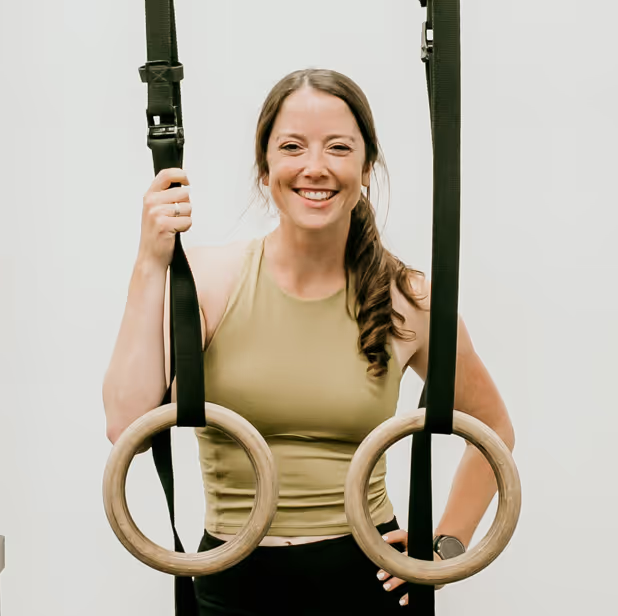
Coach Abby Heffern
14x ultramarathoner and online running and strength coach who helps ambitious adults train for marathons and ultras with structure, clarity, and a plan that fits their actual life.
Ready to Train?
Don't just show up. Show up prepared.
Whether it's a BQ attempt or your first marathon, a personalized plan makes the difference. With online running coaching, you'll get:

Don’t just show up — show up prepared.
Whether it’s your first 5K or your next 100 miler, a personalized plan makes the difference. With online running coaching, you’ll get: