October 3, 2026

October 3, 2026
The Colorado Springs Half Marathon delivers one of the most scenic half marathon courses in the West at an altitude that demands respect.
Part of the Colorado Springs Marathon event weekend, the half marathon starts and finishes at the Colorado Springs Pioneers Museum in the heart of downtown. The out-and-back course follows the Pikes Peak Greenway Trail north through Monument Valley Park, running alongside Monument Creek with views of the Rocky Mountains and Pikes Peak as a backdrop. The race is in its 13th year and draws runners looking for a well-supported, visually stunning half marathon in one of Colorado's most iconic outdoor cities.
The catch is that Colorado Springs sits at over 6,000 feet. For runners coming from sea level or low-elevation training environments, the altitude changes the entire race. Paces slow. Effort increases. What feels like an easy half marathon course on paper becomes a genuine test of preparation when the air is thinner.
If the Colorado Springs Half Marathon is on your calendar, the course will give you mountain views and a fast, largely downhill return. Your training determines whether you are in shape to enjoy it.
The half marathon follows an out-and-back course beginning at the Pioneers Museum on Vermijo Avenue. Runners head west on Colorado Avenue, drop into America the Beautiful Park, and then continue north on the Pikes Peak Greenway Trail through Monument Valley Park before turning around and retracing the route back to the finish.
The course features:
The half marathon starts alongside the full marathon field. Because the course follows a shared trail and the two distances run together until the half marathon turnaround, expect some crowding in the early miles particularly on narrower trail sections.
The race starts Saturday morning with typical early October Colorado Springs weather: crisp mornings in the 40s with daytime highs in the mid-60s, dry air, and often bluebird skies. Sun exposure is significant at altitude, even in cooler temperatures.
This is a mile-high-plus half marathon. The starting elevation is approximately 5,955 feet, and the course climbs to roughly 6,443 feet before turning around. For runners who live and train below 2,000 feet, the reduced oxygen availability at this altitude is not trivial. Heart rates run higher at the same effort. Breathing feels less efficient. Recovery between surges takes longer.
The altitude effect is subtle enough that some runners dismiss it and then wonder why their pace was 30 to 60 seconds per mile slower than expected. It is not a fitness failure. It is physics.
The Pikes Peak Greenway Trail is a multi-use path running alongside Monument Creek through the heart of Colorado Springs. Monument Valley Park, one of the city's oldest and most scenic parks, lines the route with mature trees, open meadows, and creek views. The trail is wide, well-maintained, and largely car-free. A pleasant racing surface that feels more like trail running than a typical road race.
The mixed surface --concrete, hard-packed gravel, and pavement -- adds variety underfoot and is easier on the legs than a fully paved course.
The course has a net uphill profile on the way out and a corresponding downhill return. The elevation change is moderate — roughly 400 feet of gain for the half marathon — but it is steady. The first half feels harder than it should because you are climbing gradually at altitude. The second half rewards patience: the return miles are faster, your legs feel lighter, and the finish line is downhill.
This is a course that strongly favors a conservative first half and a confident negative split.
Colorado Springs sits at the base of Pikes Peak and is surrounded by some of the most iconic outdoor attractions in the state. Garden of the Gods, the Manitou Incline, the U.S. Air Force Academy, and the U.S. Olympic and Paralympic Training Center and Museum. For runners looking to pair a race with a destination weekend, the setting is hard to beat.
This is a moderate-elevation course with a straightforward profile: up on the way out, down on the way back.
Runners should expect:
The elevation change is not dramatic, but the altitude amplifies its effect. A 400-foot climb that would be imperceptible at sea level becomes a factor when your body is processing less oxygen per breath.
If you are training for your first half marathon, here is how marathon training coaching works.
If you live and train below 3,000 feet, the altitude at Colorado Springs will affect your race. The degree varies by individual, but nearly every low-elevation runner reports some performance impact at 6,000 feet.
Strategies to mitigate the effect:
The out-and-back format with an uphill first half and downhill return is a gift if you execute it correctly. Run the first half conservatively, at an effort that feels controlled and sustainable. Accept the slower splits. Trust that the return miles will be faster without additional effort.
Training should include:
The Greenway Trail is not a smooth road. Sections of hard-packed gravel, concrete, and pavement alternate throughout the course. The gravel sections are well-maintained but softer underfoot than asphalt, which slightly increases muscular demand.
Practice running on mixed surfaces. If you have access to paved trail, crushed gravel paths, or packed dirt, include them in your long runs. Your feet and lower legs will thank you on race day.
The downhill return demands quad and glute strength to maintain pace without losing form. Runners who have not trained for sustained downhill running tend to brake with every stride, landing heavy, shortening their gait, and losing the speed advantage the course gives them.
(See: Strength Training for Runners)
Yes — with one important consideration.
The course is well-organized. The out-and-back format is simple to navigate. The trail surface is pleasant. The aid station coverage is strong. The October weather is typically ideal for distance running. And the scenery — Pikes Peak, the Front Range, Monument Creek — makes the miles pass with something beautiful to look at in every direction.
The one consideration is altitude. If you live at or near sea level and have never raced above 5,000 feet, your body will notice the difference. This does not make the race a bad choice for a first-timer but it means your pace expectations need to be adjusted, and your training should emphasize effort-based running rather than pace-based targets.
Come in with realistic goals and a willingness to run by feel, and Colorado Springs is an excellent first half marathon.
If you are running your first half marathon and want to finish feeling strong, schedule a free consult to talk through your training.
This race is a strong fit for runners who:
It is fast enough for PR-chasers who account for the altitude, and scenic enough for runners who care more about the experience than the clock.
If the Colorado Springs Half Marathon is on your calendar, your training should reflect what the course actually demands: the aerobic fitness to race at 6,000+ feet, the discipline to run a conservative first half on the uphill, the strength to capitalize on the downhill return, and the consistency to arrive at the start line in downtown Colorado Springs ready for all of it.
Wild Dog Athletics provides personalized running coaching for high-achieving adults training for meaningful goals without sacrificing the rest of their lives.
→ Apply for 1:1 Running & Strength Coaching
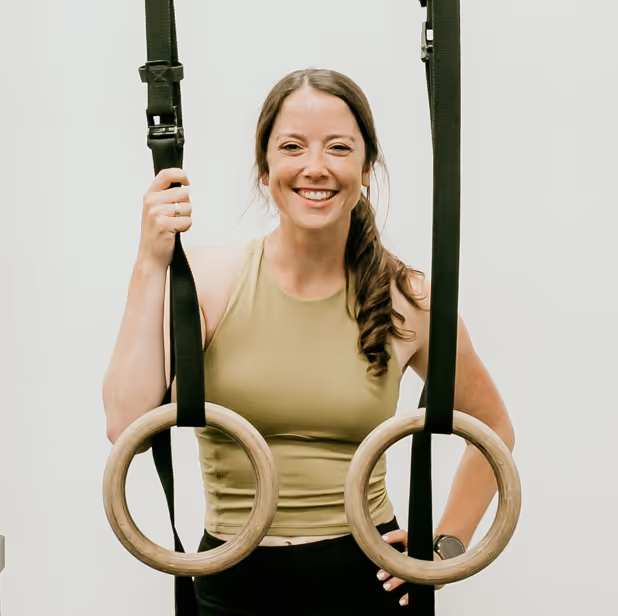
Coach Abby Heffern
14x ultramarathoner and online running and strength coach who helps ambitious adults train for marathons and ultras with structure, clarity, and a plan that fits their actual life.
Ready to Train?
Don't just show up — show up prepared.
Whether it's your first half marathon or your next altitude challenge, a personalized plan makes the difference. With online running coaching, you'll get:

Don’t just show up — show up prepared.
Whether it’s your first 5K or your next 100 miler, a personalized plan makes the difference. With online running coaching, you’ll get: